
By YI Team
“Can I have my phone?”
It is a question many parents hear almost every day. After school, during weekends or whenever children have free time, screens can quickly become their preferred source of entertainment.
Parents respond with familiar suggestions: “Go read a book,” “Play outside,” or “Find something creative to do.” But how can we make offline activities interesting enough that children genuinely want to participate?
The answer does not necessarily involve strict screen-time rules, expensive activity kits or packed schedules. Sometimes, the most meaningful experiences begin with ordinary activities: planting a seed, preparing a snack, helping a sibling or learning something new.
Here are 15 practical screen-free activities for children aged 5–15 that Indian families can adapt to different ages, interests and routines.
Why Screen-Free Activities Matter
Technology is part of modern childhood. Children use devices for education, communication, entertainment and creativity. The aim is not to remove technology completely but to leave room for movement, discovery, imagination and real-world interaction.
UNICEF Parenting offers screen-free play ideas that encourage children to explore and learn. Physical activity also matters: the US Centers for Disease Control and Prevention recommends at least 60 minutes of moderate-to-vigorous activity daily for children aged 6–17. Younger children have different activity needs.
Not every offline activity needs to involve exercise. Reading, cooking, crafting and helping at home offer different opportunities to practise useful skills. The key is variety, age-appropriate participation and genuine enjoyment.
1. Start a Mini Kitchen Garden
Suggested ages: 5–15 · Skills: responsibility, patience, observation
A few pots on a balcony or near a sunny window can become a mini garden. Children might grow coriander, mint, methi or another suitable plant. Younger children can water it with supervision; older children can track changes over several weeks.
Try this: Give your child responsibility for one plant and invite them to draw or describe its progress every three days.
2. Prepare a Simple Family Snack
Suggested ages: 7–15, with adult supervision · Skills: planning, independence, cooperation
Fruit chaat, sandwiches and simple salads are good starting points. Younger children can wash produce or arrange ingredients. Older children can measure quantities, follow a recipe and help clean up.
Adults should manage sharp tools, hot surfaces and other hazards according to the child’s abilities.
Try this: Let your child choose one snack to help prepare each weekend.
3. Organise a Personal Study Space
Suggested ages: 5–15 · Skills: organisation, responsibility, independence
Instead of repeatedly asking children to tidy their desks, invite them to decide where books, notebooks and stationery belong. Younger children can use picture labels. Teenagers can organise school supplies and their study schedules.
The goal is not a perfect desk. It is giving children ownership of a manageable space.
Try this: Create a five-minute desk reset at the end of the school day.
4. Create a Family Reading Hour
Suggested ages: 5–15 · Skills: curiosity, communication, sustained attention
Reading should not always feel like another school assignment. Stories, comics, biographies and books about a child’s interests all count. Parents can read alongside younger children, while older children choose their own books.
Try this: Spend 15 minutes reading together and share one interesting thought afterwards.
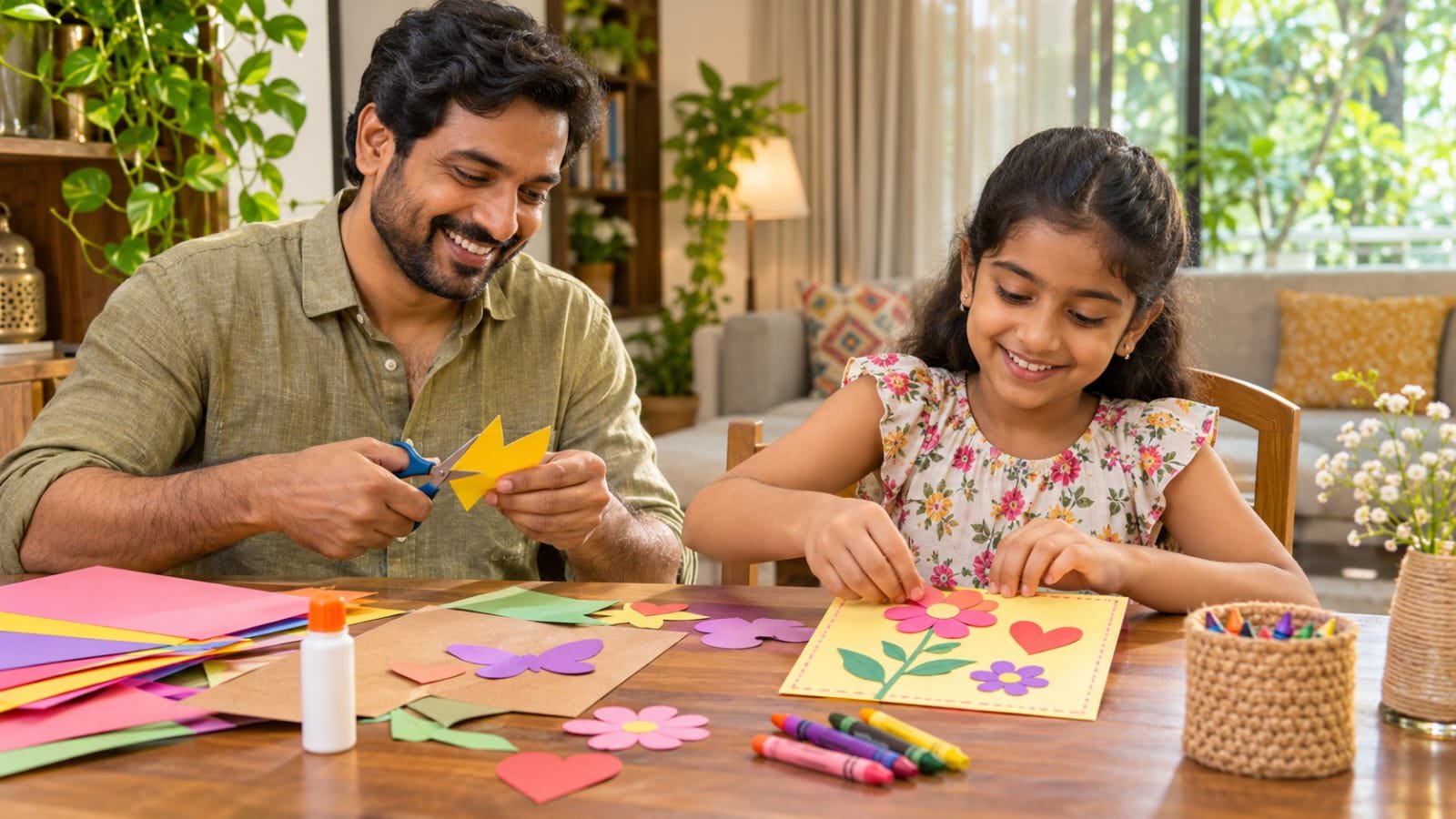
5. Write a Letter to Someone Special
Suggested ages: 6–15 · Skills: communication, gratitude, empathy
A handwritten message to a grandparent, teacher or friend can make an ordinary afternoon meaningful. Younger children can draw pictures or dictate their message; older children can write about a memory or something they appreciate.
Try this: Make a thank-you card for someone who has helped your family.
6. Rediscover Traditional Indian Games
Suggested ages: 6–15 · Skills: teamwork, movement, problem-solving
Introduce children to kho-kho, kabaddi, stapu, lagori or age-appropriate traditional board games. Choose activities that suit the available space and supervise physical play. Grandparents may have stories about the games they played growing up.
Try this: Hold a family games evening featuring one traditional game.
7. Plan a Small Family Budget
Suggested ages: 10–15 · Skills: decision-making, planning, financial awareness
Give your child a hypothetical ₹500 budget for a picnic or small celebration. Ask them to compare options, identify essential items and explain their choices. This is not about making children responsible for household finances; it is an opportunity to practise thoughtful decisions.
Try this: Plan a pretend ₹500 picnic and discuss what you would buy first.
8. Build Something from Reusable Materials
Suggested ages: 5–15 · Skills: creativity, resourcefulness, problem-solving
Clean cardboard boxes, paper and other child-safe reusable materials can become a pencil holder, a model house, a collage or a homemade board game. Let children experiment rather than insisting that the result match a picture. Adults should handle sharp cutting tools.
Try this: Make something useful from three reusable household items.
9. Take Responsibility for One Household Task
Suggested ages: 5–15 · Skills: cooperation, consistency, independence
A young child can sort toys or books. An older child might fold laundry, prepare their schoolbag or help maintain a shared space. Tasks should be safe, age-appropriate and shared fairly among family members, regardless of gender.
Try this: Let your child choose one manageable household responsibility for the week.
10. Explore Nature Without a Screen
Suggested ages: 5–15 · Skills: observation, curiosity, environmental awareness
A walk in a park or safe neighbourhood space can become a discovery activity. Look for different leaves, birds, colours or sounds. Older children can keep a nature journal; younger children can describe what they noticed from memory.
Try this: Find five interesting things on a nature walk without photographing them.
11. Organise a Family Storytelling Evening
Suggested ages: 5–15 · Skills: listening, imagination, expression
Invite parents, grandparents and children to share memories, traditional tales or imaginary adventures. Young children can add characters; older children can write or act out short scenes.
Try this: Begin a story with one sentence and let each family member add the next part.
12. Learn One Practical Life Skill
Suggested ages: 8–15 · Skills: confidence, planning, independence
Depending on age and maturity, children can learn to sew a button with supervision, organise a travel bag, read a simple map, care for personal belongings or prepare a useful checklist.
Try this: Choose one practical skill to learn together each month.
13. Plan a Family Activity
Suggested ages: 5–15 · Skills: leadership, cooperation, decision-making
Let children help organise a picnic, board-game session, indoor treasure hunt or storytelling evening. Younger children can choose between a few options. Older children can make a plan, gather materials and estimate the time needed. Parents remain responsible for safety.
Try this: Give your child ownership of a 30-minute family activity this Sunday.
14. Start a Seven-Day Creativity Project
Suggested ages: 7–15 · Skills: imagination, perseverance, project planning
A comic book, scrapbook, homemade board game or simple model gives children something to develop over several days. Let the project reflect their interests. The finished result matters less than the opportunity to explore and follow through.
Try this: Choose one project and share the result with the family after seven days.
15. Practise One Act of Kindness
Suggested ages: 5–15 · Skills: empathy, cooperation, social responsibility
Helping a sibling, thanking a teacher, assisting a grandparent or taking part in an age-appropriate community activity can make kindness tangible. Encourage children to understand another person’s needs rather than expecting a prize for every action.
Try this: Choose one thoughtful action to take this week.
Which Activities Suit Different Ages?
These suggestions are flexible. A child’s interests and abilities matter more than a strict age boundary.
| Age group | Good starting points |
| 5–8 years | Watering plants, picture books, storytelling, sorting toys, greeting cards |
| 9–12 years | Cooking with supervision, crafts, traditional games, organising a study space |
| 13–15 years | Budget planning, personal projects, life skills, organising family activities |
Adapt materials and activities for accessibility needs. Leave room for rest and unstructured play: not every free moment needs a task or measurable outcome.
Turning Activities into Everyday Habits
Trying an activity once can be enjoyable. If your family wants to continue it, begin with one or two realistic routines rather than a long list. Reading could happen after dinner; watering plants might fit into a morning routine; helping prepare a snack might work on Sundays.
Let children contribute to the plan. A paper calendar, checklist or shared family discussion can make expectations clearer. Recognise effort, accept imperfect days and gradually give children more ownership.
For more ideas, see Young Influx’s earlier article, How to Build Good Habits in Children Without Constant Reminders.
Can Technology Encourage Offline Activities?
Technology is often associated with screen time, but it can also provide structure around activities that happen away from screens. A digital tool cannot replace planting a seed, reading a story or helping someone at home. It can help families agree on an activity and recognise progress afterwards.
One example is UpZi, an Indian family-focused app that helps parents encourage meaningful real-world tasks and positive habits.
Parents create age-appropriate activities—such as reading, gardening or organising a study space—and decide the expectations and deadlines. Children can see assigned tasks and submit photo or voice proof when required. Parents review and approve the work. XP, streaks and badges make progress visible and are motivational features, not money.
Families who choose monetary rewards can also connect approved tasks with pocket-money promises and parent-controlled digital gold savings. UpZi tracks the promised cash portion; parents pay that outside the app. The focus remains the real-world activity and the habit it can help establish.
Learn more at UpZi, available on Google Play and the Apple App Store.
A Simple Seven-Day Screen-Free Challenge
If you’re unsure where to begin, try this flexible family challenge:
| Day | Activity | Suggested time |
| Monday | Read something enjoyable | 15 minutes |
| Tuesday | Organise a study table or bookshelf | 10 minutes |
| Wednesday | Water plants or explore nature | 15 minutes |
| Thursday | Create a drawing or handmade card | 20 minutes |
| Friday | Help prepare a simple snack | 20 minutes |
| Saturday | Play an outdoor or traditional game | 30 minutes |
| Sunday | Plan a family activity | 30 minutes |
This is an invitation, not a competition. Adjust activities to suit age, school commitments, energy levels and interests. If a day is missed, simply continue when it works for your family.
Small Experiences Can Create Meaningful Memories
Some of the most memorable childhood experiences do not require expensive toys or elaborate plans. They happen while planting seeds with a parent, preparing a meal, learning a game or listening to a grandparent’s story.
The goal does not have to be a completely screen-free childhood. A more realistic goal is a childhood with plenty of space for real-world experiences.
Start with one small activity. Let your child make it their own. Give those everyday moments room to grow.
Further Reading



🌱 Small activities today can build lifelong skills tomorrow! 💙
At UpZi, we believe childhood is about more than screens and textbooks. From gardening and creativity to helping at home, every meaningful offline activity is an opportunity to learn, grow, and become more responsible.
Thank you, Young Influx, for sharing these wonderful ideas and encouraging parents to create more real-world experiences for their children! 🙌
✨ Small Habits. Big Dreams.
#UpZi #GoodHabits #PositiveParenting